
Less is More: Daiquiri

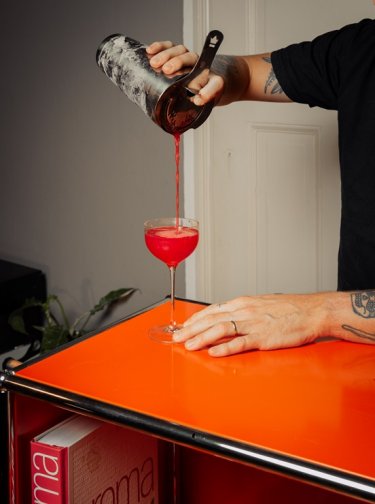
© Damien Guichard
Bar ohne Namen
Entschlossen verweigert sich Savage, der Bar einen Namen zu geben. Stattdessen sind drei klassische Design-Symbole das Logo der Trinkstätte in Dalston: ein gelbes Quadrat, ein rotes Viereck, ein blauer Kreis. Am meisten wurmt den sympathischen Franzosen dabei, dass es kein Gelbes-Dreieck-Emoji gibt. Das erschwert auf komische Weise die Kommunikation. Der Instagram Account lautet: a_bar_with_shapes-for_a_name und anderenorts tauchen die Begriffe ‘Savage Bar’ oder eben ‚Bauhaus Bar‘ auf.
Für den BCB bringt Savage nun sein Barkonzept mit und mixt für uns mit Unterstützung von Russian Standard Vodka an der perfekten Bar dazu.
Less Is More is back! After a brief hiatus for totally boring logistical reasons, we have returned to our regularly scheduled chaos.
A quick refresher: every month we take a classic cocktail and remove one key ingredient. Why? Because we’re curious and committed to understanding what actually makes a classic… classic. Balance, structure, identity — all that good stuff.
This month’s victim: the Daiquiri.
Since its creation (likely late 1800s/early 1900s, though possibly earlier if we accept that the Daiquiri is punch-adjacent), it’s fair to say the Daiquiri is the mother of all sours. Anything in the sweet + sour + booze family tree owes its top-selling success to this humble, perfectly-balanced banger,
And though the world has given us countless “daiquiri” variations — pineapple, strawberry, frozen, Hemingway, all those neon 1980s concoctions from the freezers of questionable decisions — they all share one essential thing:
Lime.
So naturally… I removed it. Because why keep things simple?
A Daiquiri must still be acidic, though, so we needed an alternative. Trouble is, citrus is incredibly hard to replace. It’s not just acidity — it’s fruitiness, brightness, and most crucially: oils. Our brains love oils and fats; they soften alcohol’s burn and make sours taste lighter and more complete. No non-citrus acid source can truly replicate that effect.
Meanwhile, Daiquiris suffered their own unfortunate glow-up in the 1980s, becoming slushy sugar bombs via the frozen aisle and industrial syrups. Recently, however, with bartenders on a post-pandemic mission to make bars fun again, many of those “disco drinks” have been revived with modern techniques and actual craft and techniques.
So! Let’s attempt a Raspberry Daiquiri-ish, shall we?
To keep things stylistically close to a classic Daiquiri — clean, bright, elegant — we’re processing raspberries with pectinex and clarifying the juice before turning it into a cordial. We don’t want a slushy, do we?
Now team we’ve done this before: for every 1000 g of fruit, add 2 g of pectinex (thanks Dave Arnold). I prefer frozen fruit because:
- It’s frozen at peak ripeness.
- It’s cheaper.
- Freezing breaks down cell walls, giving you more juice when thawed — science, baby.
Fun fact: raspberry juice has a PH level very comparable to that of citrus, which makes it all the more interesting to use as a substitute.
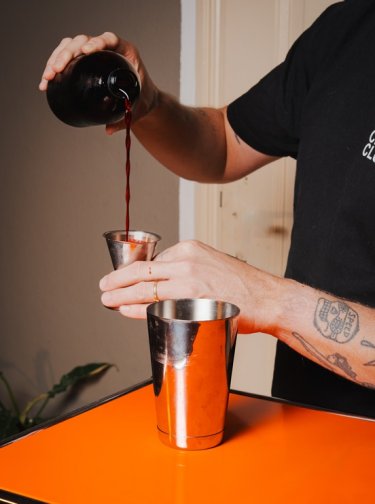
© Damien Guichard
Pectinex works best warm, but we don’t want to cook the raspberries. Toss everything into a sous-vide or zip-top bag (if, like me, your vacuum sealer gave up on you). Hold at 40°C for 20 minutes.
Strain through a coffee filter, let it drip, and now we make our cordial.
For this, we’re using fructose powder instead of regular sugar, for two reasons:
- Fructose is the dominant natural sugar in raspberries.
- It dissolves at much lower temperatures — even room temp — so you keep the juice’s fresh character.
Use a 1:3 ratio of fructose to raspberry juice.
Cordial ready? Lovely. Let’s build a drink.
- 60 ml White Rum
- 35 ml Raspberry Cordial
Shake, strain, admire.
Is it delicious? Absolutely. Sweet-tart, fragrant, silky, and unapologetically raspberry.
Is it a Daiquiri?
Absolutely not. Without citrus oils, it simply doesn’t hit the same.
But is it fun and delicious? Absolutely.
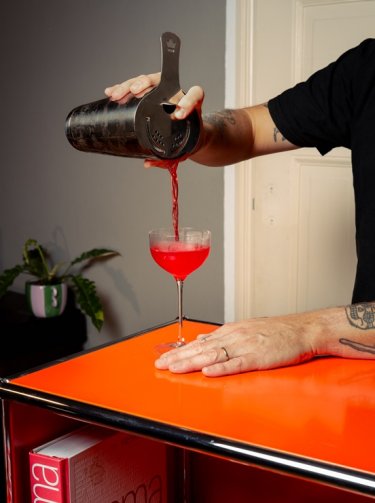
© Damien Guichard
Looking for more drinks industry insights?
Join the entire industry at BCB